
Distributed Fiber Temperature Sensing Solution
- 1. Single-ended access covers over 10 km without relay
- 2. Passive, non-conductive fiber with EMI resistance
- 3. AI-driven temperature trend analysis with zone-based alerts
All-weather temperature monitoring protects the industrial safety line.
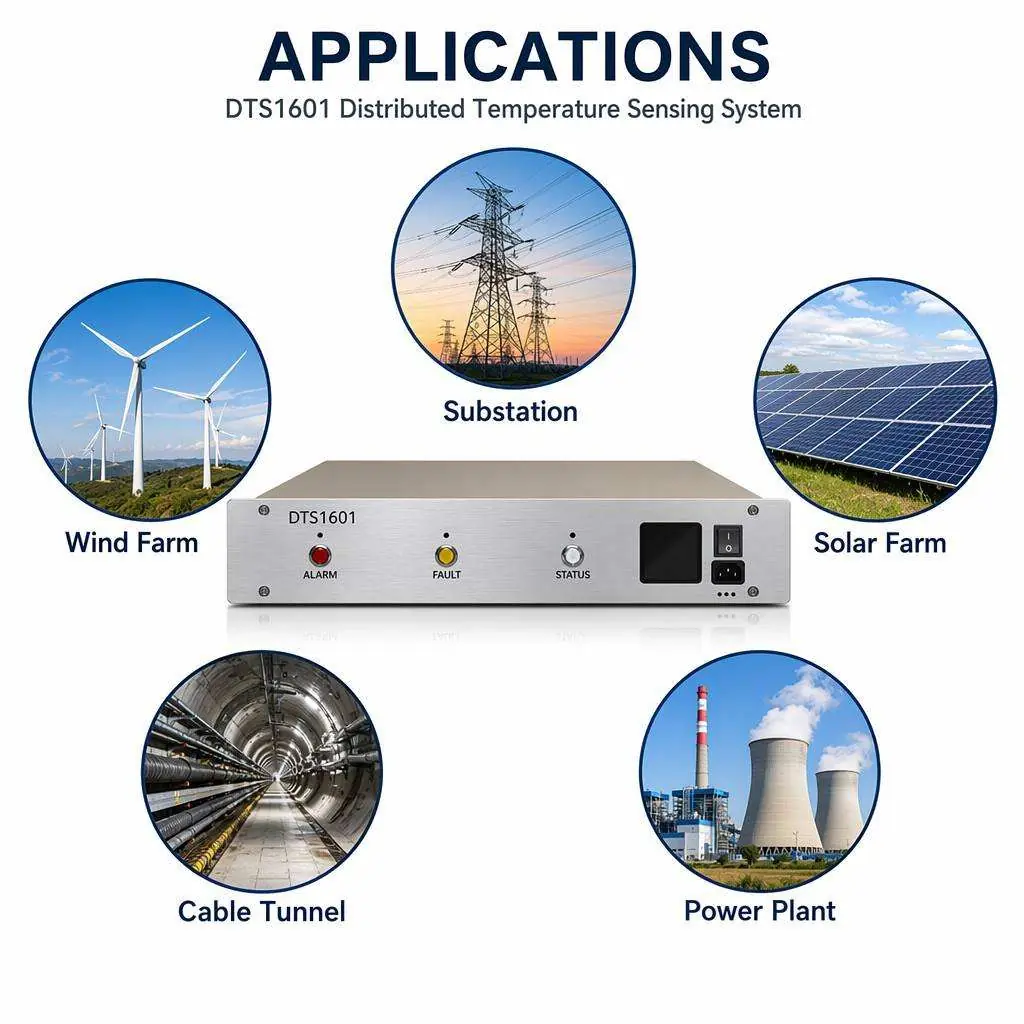
Distributed fiber temperature sensing applies to long-distance, wide-area continuous temperature monitoring in energy, transportation, municipal facilities, and industrial sites.
Technical Principle
The system is based on Raman scattering and optical time-domain reflection, sending laser pulses into the sensing cable and analyzing changes in backscattered light intensity.
It accurately calculates real-time temperature at every point along the fiber, with single-ended access covering more than 10 km for continuous temperature monitoring.
Application Scenarios
Energy: substation equipment temperature measurement and tank farm temperature monitoring.
Transportation: fire alarms and temperature monitoring along railway lines.
Municipal facilities: leakage and temperature anomaly monitoring for heating networks.
Industrial sites: equipment temperature monitoring in high-temperature metallurgy areas.
Core Value
Active prevention: alarm at the earliest stage of temperature anomalies.
Precise localization: greatly shortens troubleshooting time.
Intelligent judgment: AI analyzes temperature trends in real time and links audible and visual alarms.
Cost reduction and efficiency: avoids downtime losses caused by incidents, with zero maintenance across the lifecycle.
System Architecture
Sensing layer: industrial armored sensing cable is laid along the monitored object to collect temperature data in real time.
Transmission layer: the DTS host serves as the core processing unit, emitting laser and parsing scattering signals to calculate the temperature field.
Application layer: the monitoring platform displays temperature curves and thermal maps in real time, linking alarms, SMS, and platform notifications when triggered.
Flexible configuration: supports RS485, PLC, and third-party platforms, with zone-based alarm management and independent thresholds and linkage rules.
Scalability
The system architecture is highly scalable and can be adjusted flexibly based on the monitoring scope.